

Normal Broke Me
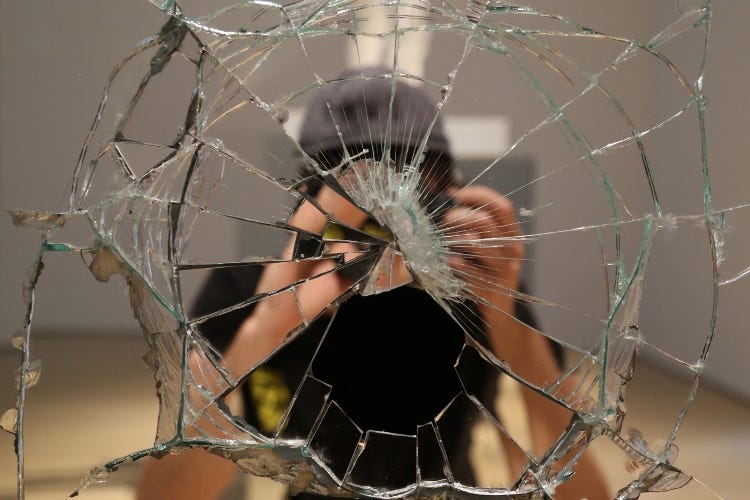
Luckily, I broke wide open

If you enjoy this story, liking and sharing it helps me reach a wider audience. Becoming a subscriber is a great way to support my work, and becoming a paying subscriber is even better! Paying subscribers enable me to offer these longer, research-informed stories for free, and they get full access to my series of “interruptions” — short reflections on simple ways we can interrupt white patriarchal narratives in our daily lives.
There are three surviving labels in my pantry. Glasses, bowls, small plates. Miraculously, they still vaguely correspond to the areas in my pantry that house our glasses, bowls, and small plates. The other labels have peeled away over the years. Our dinner plates, serving platters, and mugs perch precariously in their undesignated spaces, inviting inevitable mayhem.
I remember the day I took off from work to label the pantry and mudroom. That was back when I was Doing All the Things. Good wives and good mothers kept organized homes, and since I typically overachieved in most other areas of my life, I wanted to be even more than a good wife and mother. I was striving for the A+.
Women, I knew, were just “better” at this stuff—more “naturally suited” to it, which was why we still did most of it, even when we also engaged in paid labor. It was “normal” for me to take on the bulk of the household management, even when it meant using my precious PTO.
Though identifying as a homemaker was no longer “normal” (so unfeminist), we still made the homes nonetheless. In the small pockets of time afforded to us by the grinding gears of capitalism, we still managed our small nuclear family units, our 2.5 kids, and our proverbial white picket fences.
I didn’t necessarily aspire to “normal.” In fact, I took pride in the ways I deviated from some social norms. I’d married someone from a different race and a different income bracket, with wholly different life experiences. I had a stepson. I was my family’s income provider through two pregnancies and two childbirths. For 16 months, my husband served as a stay-at-home dad.
Neither did I have what some might consider a “normal” childhood. I grew up in a flat in the middle of a city with two parents who taught music and art. They named me after a state in India, where my father studied Maddalam drumming, and we spent our summers in various far-flung countries, including Ghana, Indonesia, Fiji, and Spain.
But despite my fierce pride in my progressive values and the various ways I smugly believed myself to be breaking convention, I still wanted to do this adulting thing right. I had a mental checklist with a corresponding timeline. I’d spend my 20s establishing some semblance of a career, marry in my late 20s, buy a home, and have two kids in my early 30s. Preferably one boy and one girl.
The checklist more or less stopped there because I assumed that with this foundation, the rest would fall into place. Somehow we’d manage to pay for college, and when we comfortably retired, we’d travel to all the countries on our bucket list and bring back souvenirs for the grandkids.
I wasn’t obsessive about this checklist, but I also didn’t question it. I didn’t engage in any deep soul-searching about what it meant to be a wife or mother. I didn’t ask myself if this was all what I really wanted.
Luckily for me, or so I thought at the time, I didn’t have to put a ton of effort into checking items off my list. The man I started dating at age 24 proposed to me at 27. I was married at 28, became a condo owner at 29, got pregnant at 30. Everything was going according to plan.
//
My first few years of motherhood were beautiful and brutal in equal measure. I spent hours during my 10-week maternity leave staring into my daughter’s black, searching eyes, gasping under the weight of my love for her.
After the spectacle of the baby shower, and despite the smiles from strangers and barrages of Facebook likes, I couldn’t believe how little regard the world seemed to have for this small human I had grown inside of me. We love celebrating births and fawning over babies, but we entirely dismiss the raw physicality and the fierce relentlessness that caring for them actually entails. I met other new mothers in a library basement, and we all looked equally stunned. What now? we wanted to know.
We were simply expected to resume business as usual, but business as usual seemed trite, bordering on absurd. “Normal,” suddenly, wasn’t quite… right. Grudgingly, I folded myself into the spaces the world allowed me. I felt myself fading into the background of my own life story. But I trudged forward. What else could I do? I was a responsible adult with a mortgage to pay. Being a mother was nothing remarkable; women had been mothers since the dawn of time.
Besides, I wasn’t done with my checklist, not yet. We needed two children, not because I felt any visceral yearning for another baby (in fact, the prospect of it exhausted and frightened me), but because we needed to complete our little nuclear family. Yes, my daughter already had a brother, my stepson, but he was 12 years older and not always around.
Every mother I knew with a second baby seemed to be unraveling. But I pretended not to notice. Having two children was “normal,” after all.
So along came Baby #2. By this point, we had moved across the country to a single-family home, and my husband was poised to start graduate school. For a few years there, life became blurry around the edges. My teenage stepson moved in with us full-time, my husband was commuting three hours round-trip to school, and my two children under five demanded constant care.
On Sunday afternoons, I stood at my kitchen counter and closed my eyes, feeling the exhaustion nestle in the marrow of my bones. I almost fell asleep, standing there. But I pried my eyes open and continued slathering peanut butter on bread. Once lunch was prepped for the week, I’d start prepping dinner.
Maybe next week, I thought, I’ll take a day off and label the pantry. Yes, yes, that will help me stave off the chaos. Plus, it’s a very wifely and motherly thing to do.
//
Mothers often speak of the intensive early years of parenting in the same way that New Englanders speak of winter. It mostly really sucks, but it’s a fact of life, and you just have to power through it.
As a displaced Californian living in New England, I frequently insisted: But winters like these are not a universal fact of life! You don’t have to suffer through them if you really don’t want to! You can live somewhere else, somewhere like… California!
We similarly delude ourselves into thinking that the brutality of early motherhood is a necessary rite of passage. That spring will arrive, the clouds will lift, and we can all have a good laugh about the insanity of it all. The insanity that we’ve come to accept as “normal.”
And oh, was I ready for spring. We were so close. My husband had graduated and found a job; our son was poised to start kindergarten. This was everything we’d been working toward. We were a two-income household with sitcom-aged kids; we would inhabit a world in which family conflicts unfolded against a backdrop of laughter.
But something wasn’t right. I didn’t know what, exactly. Maybe it was our leaky bathroom faucet. Drip drip drip. The sound was driving me insane. It wasn’t just the physical drip drip drip of water against porcelain, but also the reminder that time was passing, slipping away, like droplets down a drain.
I had finally arrived at the pinnacle of normal, but I barely had time to catch my breath. Our children needed to be dropped off and picked up from two different schools every day, and my husband and I had to travel to two different offices every day, and breakfast had to be served, lunches packed, dinner made, laundry folded, squabbles mediated, baths administered, dishes loaded, floor swept, and bedtime conquered. Rinse and repeat.
And that was the easy part. The hard part was the other crap — the appointments, emails, meetings, forms, registrations, lists. The endless lists. Work to-do lists. Weekend to-do lists. Weeknight to-do lists. Grocery lists. Packing lists. Holiday lists. Lists of books I’d never read, podcasts I’d never listen to, shows I’d never watch. Lists of all the various ways my house was falling apart.
Drip drip drip.
My husband and I were locked in a classic marital standoff, each silently hoping the other would take care of the damn faucet. It was a standoff I would inevitably lose. Finally, I looked up a YouTube video, made a run to the hardware store, did everything I was instructed to do, and…
Drip drip drip.
I was furious at our sink, furious at myself, and even more furious at my husband. But there was no time to hash things out. Fighting, like laundry and errands, was reserved for the weekend only. And our bathroom faucet would continue its smug, merciless drip drip drip through it all.
This was the course of events that led up March 12, 2020, when I found myself face down on the lawn in our backyard, sobbing. I don’t mind getting emotional in front of my children, but I prefer to sob in solitude, and our cold, damp lawn — which we had so optimistically laid down years before and which was now fraying around the edges and balding in the middle — seemed the only viable option for an all-out, chest-heaving sobbing session. Even in my semi-hysterical state, I added “fix backyard lawn” to my mental list of Shit That I Will Think About But Never Do.
The next day, the world as we knew it unraveled.
Within two weeks, my children’s schools had closed indefinitely, and my husband was out of a job, at least for a few months. I set up an office in our basement bedroom, watching my kids through the window as they traipsed up and down the path from our front yard to our backyard, sometimes on scooters, sometimes on bikes, most often with their own two (bare) feet.
There were my barefoot children playing under a merciful spring sun, and then there was the news. Businesses shuttered, jobs lost. Hospitals scrambling for supplies. The sick gasping for breath. And as weeks stretched into months, the layers of tumult continued to pile. Civil unrest, natural disasters, mothers on the brink.
There was so much going on. And yet, there wasn’t much going on at all. Suddenly, there were pockets of time to fill that simply had never existed before. Thirty minutes in the morning, during which I normally would have been commuting downtown. Empty stretches on the weekends that normally would have been filled with birthday parties and playdates. Afternoons suddenly disentangled from the mad scramble of school pickups.
I found myself sitting more (finally taking advantage of our front porch), being present with my children, spending time with my own thoughts. When I figured out a workable childcare arrangement, I walked my children home in the afternoons. I walked with them after dinner. We walked on the weekends — through city streets, up mountains, alongside rivers, behind waterfalls. We ate apples and peanut butter pretzels while gazing out at skylines, oceans, and grassy meadows.
As the worst of the pandemic began to subside, every mention of “back to normal,” made my heart catch in my throat. Of course, I missed some aspects of my pre-Covid life. I wanted my kids to go back to school. I wanted to grab a drink with friends, to spend summer weekends at our neighborhood pool.
Mostly though, I feared “back to normal.” I heard “normal,” and I thought of myself face-down on our backyard lawn. “Normal life” wasn’t sustainable, and it wasn’t that much fun. It was crammed with impossible schedules, unrealistic expectations, and simmering resentments. All against the drip drip drip of time slipping away.
Covid offered all of us an opportunity to redefine “normal,” and predictably, we blew it. In many ways, we doubled down on “normal,” leaning into the maws of the white patriarchy, fueling the hungry engines of capitalism.
Though I continued working remotely, those found pockets of time became cluttered with text threads and emails that demanded my attention. My evenings once again devolved into a blur of pickups and drop-offs. Weekends, an impossibly long list of chores to trudge through.
Here we were again, living The American Dream.
This time around, my heart was no longer in it. I’d turned 40 during the pandemic, and with my official arrival into midlife, I found myself at a crossroads. It wasn’t so much a midlife crisis as it was a midlife reckoning. I’d dutifully completed my checklist. I was a full-fledged adult — an on-time bill payer, a high-performing employee, an attentive wife, a good mother. And for what?
Normal didn’t break me all at once. It chipped away at me. Drip drip drip. It was carving me right out of my life. My days were governed by my husband’s emotions, my children’s needs, my employer’s priorities. Even during the 30 minutes I claimed for myself during my morning run, my head was cluttered with my husband’s emotions, my children’s needs, my employer’s priorities.
Something had to be done. Slowly, tentatively at first, I tried to find myself again. Enough with the pantry labels.1 Enough with the performative mothering. Enough with the career ladder. Enough with the centering of everyone’s needs except my own.
My husband was supportive, until he wasn’t. Until he realized I no longer had any intention of saving him from himself, of being his crutch, of serving as his emotional punching bag.
“You’ve changed,” he spit at me over the phone after I asked for a separation.
He was right, I’ll give him that.
//
Normal broke me; it was my divorce that broke me wide open. Perhaps it was the drama of the transition. Perhaps it was the profound, almost heady, sense of liberation I felt. Perhaps it was the ensuing revelation that the “normal” social structures so foundational to our lives are rotten at the core.
I’ve said it before, but it’s a point that bears repeating, over and over again: In the context of 200,000 to 300,000 years of human history, our modern lives are freakish, bordering on absurd. There is nothing normal about our isolated nuclear family structures. There is nothing normal about mothering with little to no social support. There is nothing normal about the number of hours we engage in labor. There is nothing normal about patriarchal power dynamics. There is nothing normal about an economy that allows for the existence of starving children and billionaires.
On the surface, my life doesn’t look drastically different. I still live in the same 120-year-old home, minus a husband. I still drive the same 19-year-old car, with a check engine light that has been illuminated for over two years. I still grumble at my kids to hang up their wet towels and put their shoes on, not around, the shoe rack. I still spend nearly half my waking hours during the week engaging in paid labor, and I still spend my evenings doing my second shift as house cleaner, chef, and chauffeur.
I’m not joining any communes, or shaving my head, or moving abroad. My days are still largely governed by the restraints of the systems I’m operating in. But the crucial difference is that I question normal at every turn, and the result is a life of more autonomy, more connection, and more joy.
When normal others most of us, something is wrong. I take some comfort in a rising generation that also seems to understand this. Only 46% of today’s children are being raised in “normal” families — that is, two parents in their first marriage. Nearly 30% of Gen Zers identify as LGBTQ+. Over 50% identify as neurodivergent. And 46% are single, with many saying that they are intentionally prioritizing themselves and their friendships before rushing into any long-term relationship. Amongst the Gen Zers who are getting married, over 40% are getting prenups, acknowledging that the institution is fragile and flawed, that it is ultimately more about money and control than it is about love.
I just hope it all sticks. My parents’ generation believed themselves to be quite counter-cultural, calling into question some of our most foundational economic and social norms. Then as the Decade of Greed commenced (corresponding with the year of my birth), most of them got married, took on mortgages, and had kids. They followed the same adulting checklist I followed, except with the advantage of far lower mortgage payments and far more accessible childcare options.
As our normal becomes more and more dystopian, it’s becoming harder to ignore the cracks. And it’s easier to call out normal for what it is — a Big Fucking Lie. For the vast majority of us, normal sucks, and none of it is really normal, besides.

I mean no offense whatsoever if you have derived joy from labeling your pantry, or any other part of your house. I actually found it quite satisfying. This is more a commentary on all the things I did in the name of being a “good wife” and “good mother.”
I’ve been a mother for 22 years now, and what struck me most is how accurately you name the slow erosion. Not burnout as a dramatic collapse, but as attrition. Drip by drip.
What looks like “normal” from the outside often feels like disappearing from the inside, especially over decades. The checklists change, the children age, the systems shift, but the expectation that mothers will absorb the excess without consequence somehow remains intact.
Reading this, I kept thinking about how many women I know who didn’t fall apart. They simply learned how to live smaller inside their own lives. You articulated something so many of us have lived without language for. Thank you for giving it words.
Another wonderful, thought provoking essay. I applaud you for being so real, talking truth. I’m also reminded of the profound importance (in my experience) of recognizing and then naming any condition we find ourselves in. That moment of sobbing in the grass was both a beginning and an ending from my point of view. How brave you were/are to fall completely into it. Xo Jane